Tuesday, April 16, 2013

Monday, March 18, 2013
Designing Wealth: The Missing Piece in the Sustainability Puzzle"
Paraphrasing from Howard Brown's recent article in Good: "Designing Wealth: The Missing Piece in the Sustainability Puzzle":
With wealth comes access to the products and services we rely upon to make our way through world the through including food, shelter, education, transportation, to name a few. But with access comes strain on and depletion of the shared resource base we tap into to generate, expand, and maintain these offerings.
In response to this impact, primary strategies to counter this downward spiral have to do with recycling, recirculating, and reusing resources, using renewable resources, and becoming more efficient at using resources. "The reality is that no matter how good we get at recycling and waste management, and no matter how efficient we become, the more resources we use, the more we lose as waste and pollution. Each time we recirculate resources, we lose some of them. Becoming more efficient doesn’t fundamentally change the relationship between resources and wealth creation. Wealth expansion has to accelerate at a rate much faster than increases in the rate of recycling or gains in efficiency. In other words, we must do much, much more with much, much less.
For Brown, the missing piece of the sustainability puzzle involves wealth production. "It isn’t really dependent on how much more resource mass we mine, but on how much more wealth we can mine from the available resource mass. Wealth is security, freedom, options, and opportunity. Wealth is weightless and invisible."
Brown goes onto to illustrate where opportunities exist, "Today, most of the products we make and depend on every day are actually mostly waste. Think about toothpaste for a moment. Why do people need it? The ultimate benefit of toothpaste is oral hygiene, or healthy teeth. What if you could eliminate the fillers, packaging, and all of the other resources associated with manufacturing, delivering, retailing, and storing toothpaste? There are scientists working today on a semi-permanent biofilm that will prevent tooth decay. Others are working on an enzyme that keeps teeth healthy. There are countless products that are material whose benefits could be delivered in an entirely different, weightless or nearly weightless way."
Brown is challenging us to expand our thinking. In addition to the models of renewability, find and develop business models where the essential need is identified first i.e. support healthy teeth and oral hygiene, and then systematically strip away all excess, so that we're designing and materializing only for that core goal. Instead of diverting our attention and resources in the development of unnecessary packaging and infrastructures, focus on "naked value" first so we can profit from designing only what is essential in helping people reach their goals.
With wealth comes access to the products and services we rely upon to make our way through world the through including food, shelter, education, transportation, to name a few. But with access comes strain on and depletion of the shared resource base we tap into to generate, expand, and maintain these offerings.
Tuesday, February 12, 2013
Not more things but better ways to….
Current
growth-based economic systems are having negative impacts socially,
environmentally, and economically. For as much as new products try and are able
to solve problems, we can’t ignore the reality that as more and more new things
get pushed into the world, a host of problems result from this forward
momentum. Because products play a role in larger systems, they can have enormous
influence on the systems in which they participate. The stresses appear across
every industry including transportation, construction, food production, and consumer
goods, to name a few.
Consider the clothing industry. Through the channels that provide “mass” and “fast” fashion the promise of affordable and “on trend” clothing is always within grasp. But this never-ending offer of newness fuels an invisible system of disposability that undermines the stability of the environments and economies in which they operate. In the US alone, 13 million pounds of textiles move annually into the landfills with no hope of ever being used again. When moved into the global reuse market, these products are proving to destabilize already fragile local foreign economies. (1,2)
Post-growth and the organizations that love it
If
pushing new goods into the world isn’t always the answer, then what other
options are out there? Individuals, businesses, and governments alike are
exploring and experimenting with new organizing principles where economies can prosper
by making use of what already exists rather than depending primarily on new
goods entering the market. Anne Thorpe in her book, Architecture & Design versus Consumerism: How Design Activism
Confronts Growth describes it like this: “A major implication of a
post-growth economy is the likely shift in emphasis from new build (or
fabrication of new goods) to maintenance, long-term management, renovation, and
retrofit.”(3) She also nods to a new type of thinking centered around use
versus ownership—one where access trumps possession.
Simply
put, new business opportunities are being designed to take existing goods and materials
and create ways to keep them in play for longer while also designing infrastructures
that provide options for access over ownership. Together they’re finding ways to
take the pressure off of new goods to carry the responsibility of economic
growth.
In
a profession that excels at systems thinking, designing new services,
infrastructures, policies, and platforms that can contribute to stable
economies is an exciting prospect. Designing invisible, stabilizing systems
may not seem as glamorous as the development of new or novel products, but this
shift from objects to systems and from products to services opens up a host of design
opportunities that are some of the most critical, challenging and rewarding problems
worth solving today.
Case Study 1: Patagonia’s Common Threads Initiative
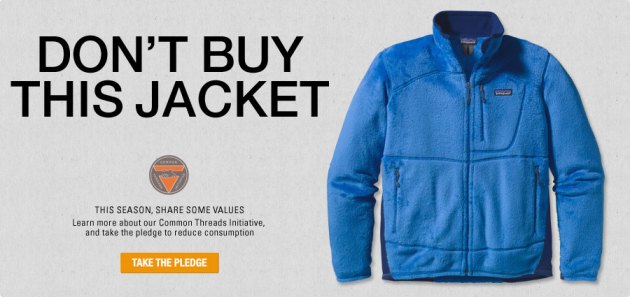
The California-based apparel company, Patagonia, recently announced a program called “Common Threads Second Home.” The service accepts used Patagonia clothing for trade-in and sale, essentially “rewarding” customers who clean out their closets and garages of their used but still serviceable products, and bring them to the company, so they can be put back into circulation. This service is part of the company’s, Common Threads Initiative, which is a larger vision of partnering with consumers to create an over-arching system of services, communications and production methods focused on maintaining resources and stabilizing consumer growth.
With sales last year of over $414M, the company is no small start up trying out some new idea. The value they’re bringing resonated enough with their customers to enable the company to make over $43M in cash and in-kind donations to date.
Case Study 2:
The Homemade Food Act and ForageSF

Economic opportunities that make use of existing
resources don’t always come from established, resource-rich businesses. Recently,
The California Assembly (along with 25 other states) has passed The Homemade Food Act. This law effectively opens the door for people
to have businesses to produce and sell their homemade foods. This new policy
supports economic growth by allowing citizens to start these small cottage industries
using existing tools and spaces i.e. the
use of their own kitchens. California is effectively removing one of the critical barriers for
these businesses, which is the need to build out “new” spaces that are
regulated and monitored by the Department of Health.
Economic opportunities compound through
organizations like ForageSF who offer wrap around services to educate
potential merchants and provide platforms to market and sell their goods.

The potential for designers
A critical part of our job as designers is to explain and even convince clients, peers, and society at-large how the world works today and as importantly, the direction it could be heading in the future. In the conscious design of objects and services that focus on resilience and access, enormous opportunities exist by improving and integrating existing product offerings with larger goal-directed systems. It’s our job to tell that story and show how it can work.
Not more things but better ways to….
If we
fast-forward and imagine a steady state, where reuse, upkeep and access are the
central drivers, we start to see a host of opportunities that serve as a
foundation for these systems including the ability to provide maintenance,
education, public access and skill building to name a few. Each of these has
the potential to provide economic, social and environmental benefits.
To make a shift
to these new models, it’s helpful to think about how individual problems and goals
fit into larger ecosystems or contexts. This helps us understand what resources
are at our disposal to help serve the needs and goals people having for using
these systems.
- Transportation: People don’t necessarily need a new car. Instead we need ways to make our vehicles last longer. We also need more compatible ways to get from A > B, so owning a car doesn’t feel like our only option.
- Healthcare: Healthcare organizations don’t necessarily need new devices. Instead, we often need better connectivity between the people and tools that already exist.
- Housing: Society doesn’t necessarily need new houses and buildings to live in. Instead we need access to spaces that can support the ways we as individuals and groups want or can afford to live.
- Clothing: We don’t necessarily need brand new clothes to update our wardrobes. Instead, we need access to clothes that are new to us. Or we need access to materials and skills that help us re-envision what we already have.

The potential for designers
A critical part of our job as designers is to explain and even convince clients, peers, and society at-large how the world works today and as importantly, the direction it could be heading in the future. In the conscious design of objects and services that focus on resilience and access, enormous opportunities exist by improving and integrating existing product offerings with larger goal-directed systems. It’s our job to tell that story and show how it can work.
For everyone
involved there are opportunities to benefit from the value and impact that
reconfiguration and increased access can provide. For businesses, like
Patagonia or ForageSF, opportunities exist to expand their reach with less
investment than when relying on new production alone. There are opportunities
to reduce the idling capacity of existing resources. And there are
opportunities to demonstrate how appropriate, forward-looking practices
translate into stronger brand perception and loyalty.
For designers
who focused on understanding human behavior, we have the opportunity to learn
about emotional drivers like trust and rewards that influence how and why we
use the products and services we do. For example in the shift from ownership to
access, the emphasis shifts from the immediate rewards based on purchase and
ownership — my car, my dress, my house — to a model where reward potentially
comes from the craft of users. Reward and stimulation are paced by new patterns
of access, such as planning ahead to reserve a car or negotiating with sharing
partners. The quality of stimulation is also different, shifting from the
getting and caring of things, to the
development of relationships within the system of use (4). With this deeper
understanding of human behavior in combination with our systems thinking
skills, we have a fighting chance of designing game-changing services,
platforms and infrastructures that move us in a positive and profitable direction.
My hope is
that as designers, we’re open to the idea that product-focused solutions may be
limiting our possibilities and our imagination for building a more stable future.
My hope too is that by aligning with existing infrastructures and by thinking
about products as part of larger goal-driven services systems rather than
stand-alone solutions, that we will uncover benefits such as increased
efficiency, access, civility, and creativity. Along the way, we’re likely find
innovative and truly satisfying ways of creating stability and longevity with
less material investment.
(2) “Used-Clothing Donations and Apparel Production in Africa", Frazer, Garth. The Economic Journal. Volume 118, Issue 532, pages 1764–1784, October 2008.
(3) Architecture & Design versus Consumerism: How Design Activism Confronts Growth. Thorpe, Anne. Earthscan. 2012.
(4) Post Growth Fashion and the Craft of the Users. Fletcher, Kate. Earthscan. 2012.
Subscribe to:
Posts (Atom)